Wednesday, July 31, 2013

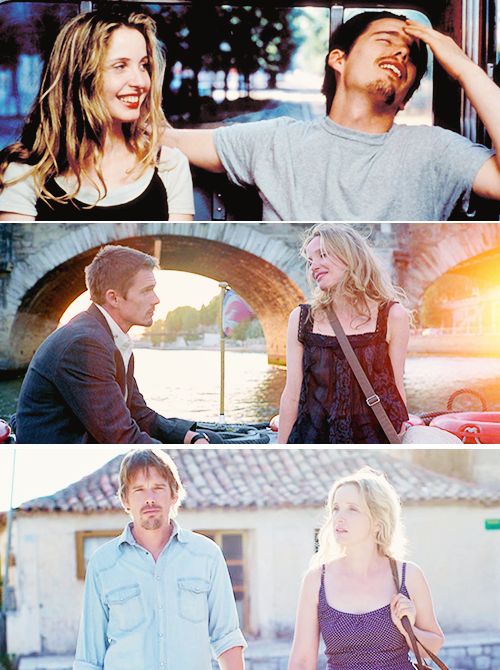
BEFORE MIDNIGHT Cuts To The Core Of You

BEFORE MIDNIGHT (directed by Richard Linklater, 2013)


"Think of it like this: jump ahead, ten, twenty years, okay, and you're married. Only your marriage doesn't have that same energy that it used to have, y'know. You start to blame your husband. You start to think about all those guys you've met in your life and what might have happened if you'd picked up with one of them, right? Well, I'm one of those guys. That's me, y'know, so think of this as time travel, from then, to now, to find out what you're missing out on."
--Jesse, "Before Sunrise" (1995)

"So tell me about this time machine."
--Celine, "Before Midnight" (2013)

There we have two scenes separated by almost two decades but bleed directly into each other. From "Before Sunrise" to "Before Sunset" and now "Before Midnight," here is film series that builds and builds relentlessly, each movie absorbing all that came before while following it to the next logical step. To see one without the others is to collapse the Jenga tower. Cinema with a memory. 

Time drags for us all. It doesn't march. It drags. And it drags slowly, damnedly, to leave us with moments enough to realize that. Little things like, "Are my teeth really this decayed?" and, "I guess this is what I'm doing with my hair now." But also bigger stuff, our possibilities delayed and our limitations lazily embraced. Life might get easier as you go, as you learn what you want and ignoring the rest. But it can also gets a whole lot more painful - the romantic ideals you once held close and the versions of yourself you assumed you'd become all steamrolling forward and slamming you into the present. 

Richard Linklater's "Before Midnight" is a beautiful movie for so many reasons. Beautiful for its lush photography of Greece that seems to come packaged in a frame. Beautiful for capturing those little moments in life between what we believe life is. But most of all it's beautiful for understanding that passage of time better than almost any movies I can remember.

Lets go back to the first movie in 1995. Two young lovers (Ethan Hawke and Julie Delpy) meet on a train bound for Vienna and discover a romantic connection so potent and out of their control, it's like they stumbled upon buried treasure. That movie chronicled where they dreamed of going. Next came part II in 2004 where they meet again for the first time, having never followed through on their plan to reunite. With characters in their early 30s, lines starting to trace their faces, that was the movie of where they went.

Now here we are again, but something's different. Not off, just different. Things are darker. More searing. Gone is the idealism that trademarked "Before Sunrise" and even the hopeful realism of "Before Sunset." Now we're left with two people in their 40s facing the unwavering realization of no where else to go. Where they once had "hopefully," now they're left with "actually."

This is the movie of where they're stuck. 

Jesse and Celine aren't kids anymore. Nor are they adults with the time to find a new path. They're married. They're parents with twin girls together. They made a life together in Europe. Now Jesse yearns to return to America and be closer with the son from his previous marriage. Celine, meanwhile, worries that she's not making enough of an impact in the non-profit sector and considers a new job with the government.

What's brilliant about the structure of "Before Midnight," though, is it doesn't dive headlong into those "Scenes From A Marriage" confrontations you read so much about. Anyone who knows Richard Linklater movies knows how much he loves putting intelligent people together and watching them be intelligent. As with the first two "Before" movies, these people have dictionaries and aren't afraid to use them. And the first half basks in the unadulterated joy of putting these two people together again, including a conversation in a car ride presented in two unbroken shots and lasting longer than ten minutes. Crucially we also get them separated for the most extended time period in the series, talking to two different groups of people, demonstrating their lives have grown and allow for others.
This is the fantasy half of the picture. The half we'd feel content to bathe in forever. The half where the two of them can still walk and talk, still amusingly bullshit each other, still share anecdotes the other person somehow hasn't heard, while inspiring thoughts in each other they didn't know they had. It's also essential to the power of the second half.

We too easily frame the first two movies as a classic love story, and that's fine - we're the audience. We can do what we want. But what's dangerous is Jesse and Celine believe the same thing. Jesse, the writer, has immortalized their multi-year courtship in his novels, and now they believe the bulletproof myth of their own fairy tale. They believe that happily ever after comes next because it's the third act and that's what happens.

Thus, when we enter the actual third act of "Before Midnight," it hits like a punch in the gut because Linklater strips away the veneer and reveals their marriage for what it is, in the early stages of decay. It relied so much on fantasy, it didn't make room for reality. Presented almost exclusively inside a hotel room, this last act harkens back to Eric Rohmer art house films of the 70s - intense, behind-closed-doors arguments where people cut loose and let what they desire fuel what they do and say. 

And the screenplay, cowritten by Linklater with Hawke and Delpy, doesn't hold back. When Jesse and Celine finally argue, they don't do it in the cute way sitcom couples fight, more akin to banter than anger. This is rough and messy, Peckinpah with words instead of bullets. They argue like people who have known each other for a long time, know the other person's sore spots, and know exactly what to say and when to say it to hurt the other person the most. 

Celine is emotional and insecure and feels reduced by the mother role she now plays. Jesse likes to believe he is pragmatic and reasonable and deep, while those descriptors are just self-applied. This isn't the marriage they signed up for. But this is the marriage they have. And like the sun they watch fade away in the distance, everything they once had planned with each other is gone. If "Before Midnight" has a happy ending (and it does), it's to Linklater's credit that nothing about it feels whitewashed. Never do these two people solve their problems. They just recognize they have them, that these problems aren't going away, and if their marriage will survive, they'll just have to accept that.

What a sad, but lovely and tender moment when it arrives.

"Before Midnight" (and really the whole series) is so many things, and the easiest label to slap is an exploration of love. Which it is. One of the best explorations of love in American movies, really. But at this point, it has evolved into something much higher. Jesse and Celine are no longer characters in an ongoing romance. They're cyphers. They're vessels in which we're encouraged to project our own desires and fears and regrets and hopes and wasted dreams. When they argue or moan for what once was, all we can do is look inward and empathize. When they're happy, it soars because we remember our best moments and realize we're still capable of them.

Ultimately what Linklater and Hawke and Delpy have done with this series (and what I hope they'll continue to do) is borderline noble, one of the noblest things art can do. They present characters who are singularly their own until we have no choice but to see ourselves, and maybe become slightly better people.

This is vital cinema.


Monday, June 24, 2013

MONSTERS UNIVERSITY Best Graded On A Pass/Fail Scale

MONSTERS UNIVERSITY (directed by Dan Scanlon, 2013)


Of all the movies for "Monsters University" to ape, who know among the most blatant would be a Vince Vaughn/Owen Wilson comedy released two weeks ago?

Not to say the comparisons to their movie "The Internship" approach a "Deep Impact"/"Armageddon" level. But lets break it down. Slobs vs. snobs conceit? Check. Movie-length competition determining the characters' fate? Check. Antagonistic supervisor secretly rooting for the heroes? Check. Two teammates bucking a system that casts them aside? Major check.

My point isn't that Pixar consciously ripped from the same well as the latest Frat Pack smarm-fest. And I'm certainly not suggesting this movie (which is actually quite charming) holds equal artistic value to Vaughn and Wilson begging you to like them. Instead I'm making the point so factual, you can etch it in granite, tattoo it over your heart: Pixar at its peak represents the best mass entertainment of the day. Their's is a self-imposed standard almost impossible to vault.

Watching "Up" or "WALL-E" or "Ratatouille" for the first time was to be absorbed in the moment. I wasn't aware of the movies' ancestors. They were movies that arrived fully-formed, risen from their own mist. As the closing credits rolled, they carried the thrilling weight of movies I couldn't bear to never see again.

Such a standard is impossible, unfair even, to expect every time. And now here we are at "Monsters University," an entry in Pixar's third franchise. Lets not get too cynical - this is an utterly pleasant movie, witty and confident, colorful and entertaining. I just felt like I had seen this before. I sat there disappointingly aware of the cloth from which this movie was cut.

If Pixar's best movies represented a bold leap forward, "Monsters University" is an agreeable circle around the block. This is family entertainment as babysitting. A reasonable alternative to sweating outside in the heat. 

There. The unpleasantness is out of the way, and now instead of talking about what the movie isn't, we can talk about what it is. As a prequel to 2001's "Monsters Inc.," maybe it isn't entirely necessary. But you know what, we also live in a world with a prequel to the "Texas Chainsaw Massacre" remake, so lets just deal with it. We meet Mike (Billy Crystal, thankfully not doing anachronistic jokes about old people trying to text) on his first day at Monsters University, dreaming of one day becoming a "scarer" at the factory from the first movie. Despite an ingrained knowledge of every scare textbook there is, he's still a silly looking green eyeball. 

Enter Sully (John Goodman), who comes from a long family line of scarers, but lacks the discipline to learn the basics. With these inadequacies threatening to get them kicked out of the scaring program, their only chance is to band together and win the Scaring Games, an epic competition designed to impress the Crotchety Old Dean  (a mainstay of any campus comedy). 

Peak Pixar felt like adult movies posing in family entertainment clothing, but this is a children's movie through and through. The colors are bright and inviting. The jokes are pitched with a fast and zany effort. While the usual bones are thrown to parents to make them laugh, too, they often hit with a pleasant, surprising force (witness one monster shrieking, "I can't go back to jail!" when security catches them breaking into a building). When the emotional payoff arrives, it does so without the usual heft that accompanies Pixar if only because the stakes feel lower. 

Family animation is by and large predictable. The trick is to temporarily fool you into thinking it isn't, and "Monsters University" isn't quite up to the task. Still, just because we can see Point C coming 'round the bend from Point B doesn't mean we can't appreciate the effort it takes to get there. Sure, the stakes feel low. But the movie deserves credit for dodging its easier message of, "You can be anything you set your mind to" for a more complicated, "Accept that you might not have what it takes," all delivered in a commendably understated manner.

Kids aren't clobbered over the head with the moral. Instead "Monsters University" comes off with an agreeable lack of self-congratulation. It knows what it wants to say, and it trusts its audience enough to absorb it through osmosis. Some movies confuse "dark" with "edgy," and "Monsters University" opts for a path that feels almost courageous today: pure, unfiltered decency.

Losing the Best Animated Feature Oscar to "Shrek" (a movie that spawned its own more embarrassing franchise), the original "Monsters Inc" doesn't get the credit it deserves. Its premise gave Pixar animators full freedom to push their imaginations and, from there, technical abilities (remember what a wow-factor something as simple as Sully's fur had back then?). More importantly, it arrived after Pixar produced only two original features and a sequel. It set them on the path of creative discovery that led to further classics.

This new one won't stand as a shining beacon leading the way. But it doesn't tarnish its own history either. If other Pixar works earned hallowed spots in my DVD collection, this one earns the right as pleasant background noise on inevitable Disney Channel airings. 

Thursday, June 20, 2013

These Zombies Are Just Running To A Better Movie

WORLD WAR Z (dir. Marc Forster, 2013)


"World War Z" is one helluva movie. It's too bad that movie takes place just outside the frame of the one we got.

Nearly everything about it feels like it should be the background to a far more interesting movie taking place elsewhere. Explosions drop and zombies suddenly appear. Major cities are leveled. Entire populations are decimated. Brad Pitt's hair gets sensually tousled.  

And yet we never get a sense of this chaos. Never get a sense for how truly epic director Marc Forster feels this story should be. Instead he offers us mere glimpses of the carnage wrought on our planet before hurriedly rushing to the next scene of exposition. 

Intriguing notions such as how North Korea defends itself against the undead are raised, then swept under the rug. A young boy attempts to tag along with Pitt before the movie realizes it doesn't know what to do with him. Israel somehow tapped into the secret of impending zombie doom before the world, but no one seems to care.

"World War Z" plays like a carnival barker pitching us the most Epic Zombie Apocalypse Ever, but when we're shilled our quarter and go around the corner, it's just a few midgets lurching around in make-up.

Such a shame, because the rote elements are assembled for an epic tale of zombie kick-assery. After a perfunctory establishing scene of former UN employee Brad Pitt with his family that establishes, well, he has a family, the movie hits the ground running. Zombies invade Philadelphia without warning and without reason, barely allowing Pitta and his family to escape. Finding his way on a UN vessel, safe in the middle of the ocean from the outbreak, he's informed the only way his family will continue enjoying these comforts is if he trots around the world on a quest for the outbreak's origin. If he can track this mysterious "Patient Zero," there might be hope for a cure.

Romero zombies slowly ambling around, these ain't. Forster's zombies rush you before you even realize, zipping around the screen as if "Yakety Sax" plays in their earbuds. Individual scenes are effective - the initial attack plunks us in the middle of sustained, unwavering terror, as Pitt and his family don't understand what is happening or why, only that if they don't move, they will die. We witness the horror, the confusion, and the sheer panic of seeing every human around you suddenly wiped out.

If only Forster sustained this feeling of large-scale dread. If only he took a step back and recognized the sheer enormity of what's at stake - the world is coming to a friggin' end! Instead, by shoehorning in Pitt's personal quest, Forster and his writers J. Michael Straczynski and Matthew Michael Carnahan awkwardly try to minimize the action while expanding it too. Imagine your local Action News team fighting to share the same studio with CNN.

As strategies go, their's isn't entirely off-base. Granting us an entry point into chaos too large to comprehend can allow personal investment. We witness a clear dramatic arc, and it provides a guiding point within the destruction. It gives us something tangible to care about. Turn to Spielberg's "War Of The Worlds" for a decent textbook on pulling this off. 

Thing is, Spielberg provided a soul beneath the veneer. His characters showed personality, flaws, concerns. You felt like their fate mattered. Forster's characters are either targets or cyphers. They exist either to get mowed down or voice plot devices the screenwriters can't step on screen and say themselves without a SAG card. For all its computer generated zombie hordes and PG-13 blood, "World War Z" is a curiously soulless affair. 

If only the zombies in this movie sought heart instead of brains. They'd be defeated in a day.

Most curious is the third act. Notorious reports of rewrites and reshoots, essentially leaving Forster to scrap the original ending and start from scratch, prepare us for an unholy mess, some blatant piece of studio meddling nonsense. And it is...but not in the ways we expect. The finale of "World War Z" ironically works as the best thing in the movie because it so clearly stands apart from the rest. 

Until then, Forster treats us with a nonstop barrage of stuff. Uninvolving, unmotivated stuff. And if it's not boring, that's only because he grants us no time to be bored. Spoilers withheld, though, the movie makes a hard right turn near the end into an alternate timeline version of "World War Z." It becomes intimate. Involving. A select few characters in tiny rooms, with a clear goal in mind, shot clearly and elegantly, cranking up the suspense.

I'm torn. This demonstrates a complete lack of faith in the filmmaking choices already made - if you're gonna shoot the most epic zombie story ever, at least follow that through to its natural progression. At the same time, the finale kinda works as a mea culpa for all that came before - "We only had seven weeks for reshoots. We know. We're sorry."

So where does that leave us? We have a hollow lead played admittedly well by Pitt, as his only requirement was showing up. We have a plot that plays like some lame Encyclopedia Brown story as he zips around from place to place ("Come see Brad Pitt learn a new fact just in time!"). We have an emotional connection bearing all the weight of a video game on your old dorm room TV. 

One thing could save this movie, and one thing along: For God's sake, shoot it well!. Mindless chaos still holds value if we enjoy it, and to enjoy action, we need some kind of grounding. We need a sense of geography, where characters are in relation to each other. Clear, steady shots to see what's happening.

We're not talking personal style. We're talking the basics. Knowing where to put the camera so the audience's brain and eyes don't give up. Forster's method of directing action feels akin to crop dusting: Cover the whole field and let the rest sort itself out. In one key moment, a character's hand is chopped off, but it's a full ten seconds before we even realize it.

When will filmmakers learn that shaky cam achieves the exact opposite of its goal? Instead of immersing us in the action by making us feel how it feels, it pulls us out because all we feel is dizzy.

Some movies are frustrating simply because they suck. "World War Z" is frustrating precisely because of how much it shouldn't have sucked. After setting out to craft the zombie movie to end all zombie movies, Pitt and Forster found themselves with a zombie movie that thankfully just ends.

PS: Sigh. Let it be known that this movie's 3D takes a giant step backward to the poster children of horrible conversion jobs, "Clash Of The Titans" and "The Last Airbender." We're at the point that 3D conversions are not perfect, but they're virtually indistinguishable from the real thing. "World War Z" evidently didn't get the memo. It's dark, blurry, and ironically, rarely seeming to ever actually use the 3D. Want to pay five extra dollars to make the movie look worse? The choice is yours.