Friday, October 4, 2013

This Entire GRAVITY Review Was Written In One Take

GRAVITY (directed by Alfonso Cuarón, 2013)


Years from now, movie lovers will ask each other, "Where were you when you saw 'Gravity?'" just like people ask each other about the JFK assassination, if the JFK assassination were, you know, a good thing.

That's not necessarily saying "Gravity" is a classic film. Not necessarily saying that it's a great film (although I personally think it's the latter). But it is a landmark film. What is it we so often demand of movies - show us something we've never seen before. "Gravity" does more than show us. It takes us there, plugs us in to the surroundings, and tears down the barriers between audience and movie, between seat and screen. Few movies I can think of create such an intensely physical experience, transferring the experience of characters to our very bones.

This is what the monoliths in "2001: A Space Odyssey" pointed to. 

Linear as an arrow, the script from director Alfonso Cuarón and his son Jonas tells a story of sheer survival that allows us to wonder, "Could I do this?" Two astronauts (George Clooney and Sandra Bullock) are in space conducting a space walk for space repairs on their space shuttle when space debris strikes (doesn't everything seem cooler with the word space?). They're robbed of all contact with Earth. Their options don't extend far beyond floating around, which they do, a lot. Alfonso and Jonas cleanly construct the ensuing 75 minutes as one thing needing to happen for the next thing to happen, otherwise no more things will happen.

There are no cuts to mission control. No flashbacks to Bullock's life back on our planet that spends the movie so cruelly in view. What little dose of spiritualism Cuarón offers could just as easily be written off as a dream. But purged of all distractions, "Gravity" finds the infinite. Lets not undersell what Cuarón accomplished here - by shooting his actors floating almost entirely outside their crafts (how often do you see that in outer space movies?), by allowing his camera to roam free through the 3D axis, by shooting his trademarked long takes with views that wobble between full background shots of Earth and the vast nothingness of stars within the same moment, and by using nonstop special effects to create a thoroughly meditative experience instead of a barrage of itself, he has done nothing less than change the very language of film.

Taken alone, that is impressive enough. But what makes "Gravity" monumental, borderline miraculous even, is Cuarón and his team do it so seamlessly. Think about your favorite special effects landmarks. The Death Star Trench Run in "Star Wars." The first T-Rex attack in "Jurassic Park." Maybe the White House explosion in "Independence Day," I dunno. Those moments are accompanied with the requisite awe. "Movie magic," as us industry insiders call it. But they also beg the immediate question, "How'd they do that?" It's part of the fun, wondering how a filmmaker pulled something off.

"Gravity" wants none of that nonsense. Once we're there, we're there, and we are absorbed. Cuarón's effects don't call attention to themselves. Instead they dazzlingly blend to create a world that feels legitimate and encompassing. It existed before Clooney and Bullock showed up, and it'll exist after they leave. As far as we're concerned, they shot this movie in space. Don't ruin the fantasy. Don't even try. 

This is where 3D becomes absolutely necessary. Trust me on this one - dig up whatever spare change you can find and splurge on the glasses. You owe yourself the spectacle. Seeing "Gravity" in 3D is the true immersive experience this tool has been waiting for, what James Cameron promised it could be. Set free from the confines of a flat plane, Cuarón's camera pivots, flips, darts, and is sometimes content to simply float and let the vastness wash over us.

It's terrifying. It's sweat-inducing. But it's also humbling and strangely inspiring, a deeply resonant experience that a week later, I'm still struggling to describe cogently. "Gravity" steadfastly never bends to emotional manipulation. When space stations are shattered by passing debris, it's with an eerie and poetic lack of sound simply because there's no sound in space. When Bullock and Clooney find themselves separated early on, it's with the cold tacitness that they might remain lost and float until they die because it's space and there's no gravity and that's just how it is.

Earth looms large throughout the movie's running time, sometimes filling the entire background. It plays like a joke that all these two people need to do is set foot back on what is so clearly in front of them. Really, outer space begins only 80 or so miles above our heads. A short road trip to visit your grandparents or see some band you like but don't even love. But once "Gravity" slips that bond, the rules change and a feeling of total, awesome insignificance seeps in. 

All begging the question of, "Why?" Why make this movie? Is it simply a special effects exercise? If so, well, bravo. It goes beyond that, though. Our actions on Earth can't help but feel important. It's all we know. But the universe is so vast and old and mystifying, and our time as a member of it is so brief. Against this barren, endless, merciless, gorgeous void, we border on nonexistence. The infinite stretches on, and we don't.

Within that framework, Cuarón chooses survival for his narrative thrust, and accompanied by an emotionally grounded, powerhouse performance from Bullock, he plunges us to a visceral situation in that very void where we have to shed the essence of who we thought we were for something stronger. We remain insignificant. Yet amongst the stars, what we do matters, if only because it matters to us. I don't know what you'll get from "Gravity." Maybe only thrills. It's a personal experience. But that's what it meant to me.

As a special effects spectacle seen on the biggest possible screen, "Gravity" is a stunner. As a cinematic experience, it brushes on transcendence.

Tuesday, October 1, 2013

With RUSH, Ron Howard Proves He Could Shoot An Awesome Beer Commercial Someday

RUSH (directed by Ron Howard, 2013)


Has any director in history turned a distinct lack of style into a bigger advantage than Ron Howard?

That's not a dig at the man. Far from it, actually. His success harkens to directors of the studio system heyday, churning out product not through a burning something to say, but because filmmaking is a job, and that job requires you to say something. Clean, no-frills storytelling still requires precision and artistry, if you consider "artistry" the willingness to stand back and know when to not try too hard. The movies might be his. They're just not his.

Howard, more often than not, is a competent pizza delivery man who takes great pride in his job. You get exactly what you ordered, on time and at the agreed-upon price, and he doesn't even stick around like a jerk waiting for a tip. That's why when he makes something unexpectedly fun like "Rush," it hits with an added jolt. This isn't a for-hire director shooting the script. This is Richie Cuningham waking up one day and deciding to be the Fonz!

You know what? It actually works. Maybe this is just what happens to a director when he realizes his last movie was a Kevin James/Vince Vaughn comedy, but Ron Howard strove for something kinetic and layered and adult, and damn if he doesn't (mostly) pull it off.

Set in the rarely-visited world of Formula One racing, "Rush" concerns the true story of two drivers whose star is on the rise - James Hunt (Chris Hemsworth, relishing the opportunity to show some personality) and Niki Lauda (Daniel Brühl). As portrayed in Peter Morgan's screenplay, Hunt cares more about celebrity than the intricacies of racing itself, while Lauda approaches winning with level-headed rationality, believing it can be taught like any science. Morgan argues their clashing personalities drove each other to succeed more than spouses or coaches or prizes, to the point that they need the half of a person that the other provides. Why, an observant viewer might even say they're two sides of the same coin.

Lets start with what "Rush" isn't. It isn't deep. Once Morgan and Howard establish the yin and yang relationship of the characters, there aren't many ways to go but sideways. Hunt pulls Lauda one way. Lauda pulls him in the other. Morgan's screenplay doesn't follow a theme as much as it establishes a theme and replays it. All this is interesting on a conceptual level, but dramatically it falls short, as the lives of these men never sizzle as much as when they're behind the wheel.

"Rush" also isn't sexy, at least not as much as it thinks it is. Set free by the limitless R rating, Howard reminds us that he's also the guy who made the bawdy 80s comedy "Night Shift," but he's also the guy who made the PG...most everything else. "Rush" so clearly wants to delight in the decadence of celebrity, tossing bare breasts and champagne around with a devil-may-care casualness. Something about it feels oddly off, though. If it's sexy, it's sexy like a trembling, nerdy virgin traveling to Amsterdam hoping to meet a high class prostitute. Her moves might feel erotic, but that don't mean they're real.

But enough wet blanket talk. Where "Rush" shines, and I mean really shines, is the kinetic gamesmenship on display. On the track, it feels more alive and visceral than almost any racing movie I can remember. Howard often finds himself lashed for his trademarked "solid" craftsmanship, but here it's set to full, clear-eyed advantage. His wide establishing shots allow understanding of geography. Crisp editing creates consistent placement in the action - we know where everyone is and where they're trying to be. And virtuoso special effects push the races to "You are there" extremes, with the tires almost flinging mud in our faces. Here is a movie where 3D would be superfluous.

This same earnestness carries over to the dynamic between our two leads. "Rush" doesn't have a lot to say about the nature of human nature or competition, but lets also consider how it's saying it. Grab any sports movie about a personal rivalry at random and you're almost sure to find a clear-cut pro- and antagonist. Maybe they reach the inevitable begrudging respect. Maybe they even become friends in a sequel. But the dividing lines are clear - this is who you root for, and this is who stands in his way. 

"Rush" travels the far more interesting route of shifting protagonists. As the movie progresses, sometimes even within a single scene, our loyalties move like a sliding scale. Our desire to see Hunt win is never greater than Lauda, and vice versa. By the destined "big race" in the end, one character makes a crucial decision that all but guarantees victory for the other, and yet when that victory comes, our fists aren't driven to pump. Victory and defeat aren't on "Rush's" mind. Instead it crafts two well-defined characters and asks us to consider what they mean for each other. A worthy, even noble, goal for a sports movie. You half-expect them to pull a "Rocky III" and challenge each other to a private race in the end, freeze framing just as they hit the gas.

More than anything, "Rush" represents Howard's glee of playing in the sandbox. All too willing to stand as a punching bag for those who believe themselves above the middlebrow, Howard still seems to like making movies. I mean, really just likes making them. "Rush" takes a while to find its feet (the first half feels noticeably muddier as we get used to the ping-pong structure between Hemsworth and Brühl), and once it does, it's content to hit the beats.

Howard's earnestness shines above all, though. As long as he believes in the story this much, I'm willing to go along for the ride. "Rush" doesn't add up to as much as it could, but it has a blast doing so.

Saturday, August 31, 2013

Uproarious THE WORLD'S END Gives You No Desire To Drink Alone

THE WORLD'S END (directed by Edgar Wright, 2013)


God, I love it when a movie is exactly as good as I hoped it would be.

Six years after "Hot Fuzz" and almost a decade since "Shaun Of The Dead," actors Simon Pegg and Nick Frost once again team with master genre satirist/fetishist Edgar Wright for "The World's End," a result that is quite simply joy incarnate. Laughs roll fast and fierce, Wright keeps the pacing at a steady clip, and to watch it with a receptive audience is to become gradually aware that we're sharing something special and we all know it.

2013 will probably yield better movies. But there won't be another more wholly entertaining. This is a movie not only for people who love movies, but for people who want to love movies.

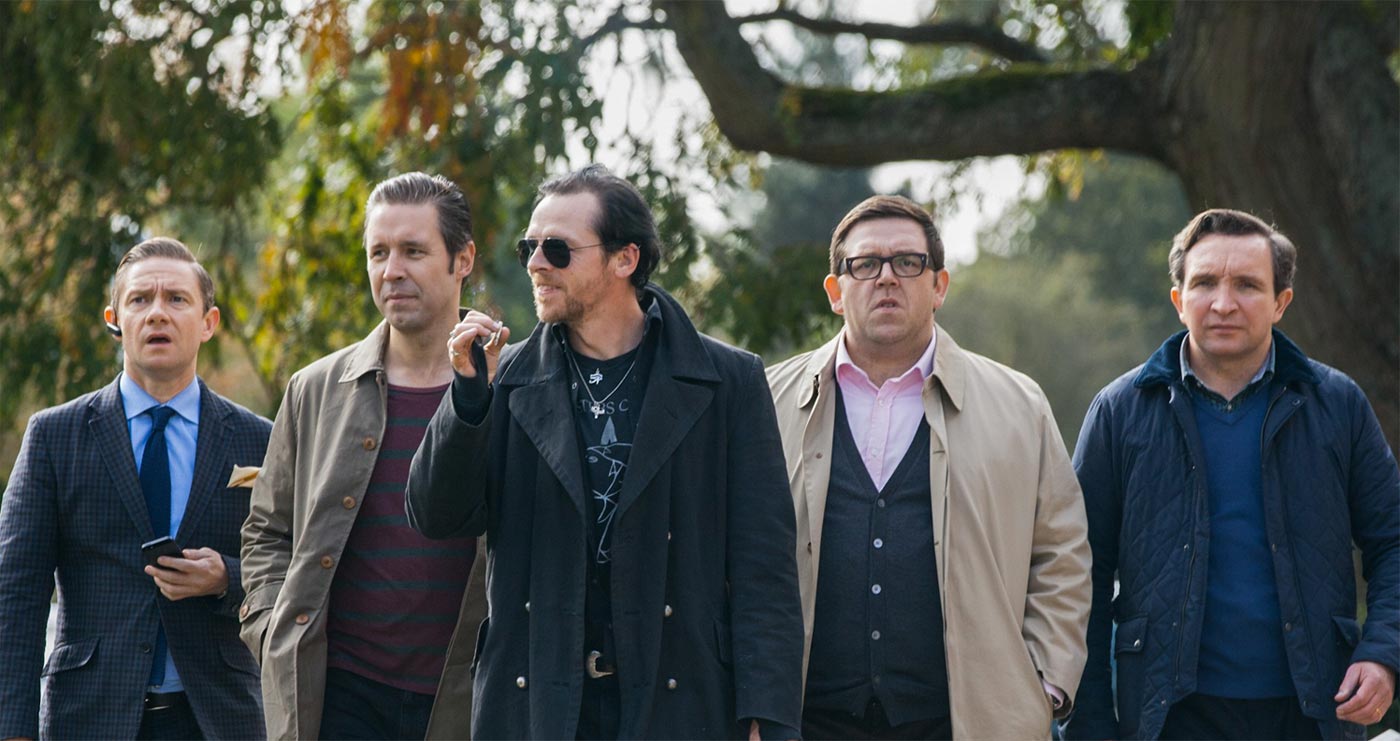
As the last installment in their Three Flavours Cornetto trilogy, it's only fitting that "The World's End" concerns a band of old friends getting back together for one last hurrah. Gary King (Pegg) remains obsessed with one of the formative nights of his wayward youth: a 12 stop pub crawl called The Golden Mile, culminating in a visit with the good Dr. Ink at a place called The World's End. Unlike the friends he shared that night of debauchery with, though, Gary never got over the fact that they never finished the crawl. He still rocks the same Sisters Of Mercy tshirt and black overcoat he wore then. Now, a grown man with nowhere to go because he never chose a path, he coerces everyone (Martin Freeman, Paddy Considine, Eddie Marsan, and Frost) into giving the epic crawl another go, playing the sympathy card of his recently deceased mother. Almost like a heist movie, if the theft were of their dignity.

Vain attempts to recapture faded glory. A stunted manchild unwilling to accept that his friends moved past him. The danger from living in the past. These are the themes that concern "The World's End," and until the halfway point, Wright plays it mostly straight, his cards close to the chest. Knowing the strokes of a Cornetto movie, we're waiting for the other shoe to drop, for the true nature of the movie to pop its head. Key to its success, though is we're not antsy. You've seen the trailers. You know it's ultimately a send-up of science fiction, with the residents of the gang's old town replaced by pod people. And when Wright fully pulls back the curtain, it doesn't play like a sigh of relief - "Finally, we can get to the good stuff."

That's because Wright's method of satire directs as much inward as it does outward. He's patient. He's careful. In "The World's End," he takes his sweet time to create real human situations that we feel empathy for, so when the movie's gears irrevocably shift to sci-fi, it feels like a logical progression of the plot we're now firmly invested in. Were Pegg and Wright lazy people, they'd just show off their intimate knowledge of a genre they know so well, and "The World's End" would be a fun game of, "Remember when this happened in those older movies?" 

Thankfully, ambition is something they don't lack, and "The World's End" warps the familiar tropes of sci-fi to its own purpose. Pod people as they approach them really stand for the disappointment we all feel when we return to a place frozen in our minds - where the pubs had character - then facing the rude awakening that everything's changed and it's all Starbucks-ed (as one character says). It's when you reunite with old friends and assume you can launch into the same conversation as when you left off, only to discover that with years between you, you've both started different sentences.

Gary never gave up on his noble little dream that 12 pints can save his life. And the ultimate greatness of "The World's End" lies in the fact that it kind of believes him. Wright and Pegg might bow before the conventions of genre, but they don't force themselves on character. As their movie builds to its oddly affecting conclusion, there's an audaciousness to this modern comedy about arrested development acknowledging that deep down, human beings really don't grow that much - we just make the same mistakes in different places. Immaturity need not be corrosive. And instead of forcing ourselves to mature, maybe we'd have better luck trying to be happier as we are.

As artists, Pegg and Wright no doubt believe in personal growth and pushing themselves to new heights. That still doesn't give them the right to lecture, and in this tale of "Withnail & Sci," allowing a character who is ultimately pathetic to revel in his patheticness is bold and kinda admirable. For a movie that knows exactly what it wants to say, "The World's End" never gives way to cockiness or self-importance. It simply struts along, knowing the heart sometimes works better on the sleeve.

What sheer, glowing enthusiasm Wright shoots this all with, too. What gleeful kinetics. Roger Ebert was so fond of quoting Francois Truffaut, "I demand that a film express either the joy of making cinema or the agony of making cinema. I am not at all interested in anything in between." This movie absolutely represents the former. When Wright stages a massive pub fight toward the end, camera darting throughout, characters swigging beer between punches, it's with the same unhinged passion that marked his great "Scott Pilgrim Vs. The World," and you think here are people who are so incredibly proud to be making movies.

Shooting comedy can be so easy. Take funny people, put them in front of a static camera, and off you go. Is there a better comedic director alive today than Wright, though? Not just in his ability to pace the jokes and present them, but to interpret them? Watching a Wright comedy, you get laughs when the camera cuts just as surely as when the actors land a funny line. Movies are a visual medium, and he wants his camera to play an active role. 

I'm just so happy when a movie like this comes along, and I'd endure a dozen "Hangover III"s and "The Internship"s for it. It clicks in the ways you want and in the ways you didn't even expect. It's unrelentingly funny. It exudes complete confidence. It's overall just a great, rowdy affair. 

For a movie about people gladly crawling back to the bottom, Wright and Pegg end their trilogy never artistically richer. Kieślowski ain't got nothing on these Three Flavours.

Friday, August 30, 2013

BLUE JASMINE Is One Bitter Pill About White Lies

BLUE JASMINE (directed by Woody Allen, 2013)


"Blue Jasmine" hadn't even started, and it already felt like a lie.

Lights go down. Electric curtain draws. Audience members rush to finish conversations. All standard operating procedure as the projector starts. Then the digital screen widens to scope. A Woody Allen movie not shot in flat? What is this, "Manhattan"? 

Then, of course, the familiar white Windsor font set to jazz launches, which always grants me the immediate feeling that I made the right decision, and we're firmly back in Woody terrain. Still, that momentary jolt, that feeling that all is not what we assumed, rings appropriate for "Blue Jasmine," which barely contains a scene in which all characters have access to the exact same information. Most Allen movies transcend their times by speaking to some fundamental human natures; make a few minor modifications, and they coulda been shot in any year. "Blue Jasmine" is among his few, though, that feels completely, vitally now. When was the last time one of his movies even referenced current events, let alone required them for the plot?

When we first meet Jasmine (a luminously unbalanced Cate Blanchett), she's on a plane bound for San Francisco, chatting it up with the stranger next to her. Jasmine regales the new friend with stories of attending Boston University until she met her future husband Hal (Alec Baldwin, inhabiting like a glove the role of charismatic sleazeball). From then on, nothing but Park Avenue and the Hamptons and a life of privilege that makes one forget there's a world around you.

Only then the plane lands, and Jasmine is alone, conspicuously no husband to greet her. That woman who offered a friendly ear on the plane is now nothing more than a stranger standing at baggage claim with a wall of silence between them. As our heroine who flew first class and sports gargantuan sunglasses takes a cab to apparently move in with her working class sister (Sally Hawkins), suddenly that bit from the plane about her lush lifestyle seems less like a story she tells others and more like a story she tells herself.

And there, in a nutshell, arrives the core of "Blue Jasmine" - all the lies, both white and major, that we tell to get through parties, to get through dates, and just to get through our day. Almost everyone in this movie spins some kind of fiction, but it's rarely to hurt anyone else so much as to as to act out the reality we wish to be true. Here is a group of characters who heed to the end the immortal wisdom of George Costanza, "It's not a lie if you believe in it."

Lets put it another way. There's basically one character in this movie who's completely, morally upfront with everybody, and he's played by Andrew Dice Clay.

For a director almost entirely known for his work in New York, it's no accident that Allen moves the bulk of the action in "Blue Jasmine" to San Francisco. While NYC feels like a city where people jockey for space with the version of themselves they want you to see, San Francisco is more a place where you can let fly whatever flag you hold. It's a city where you can stop pretending and just exist. After suffering trauma in New York I won't describe here, Jasmine goes west, young man. But the movie's bicoastal irony is that Jasmine traveled 3000 miles to a city that doesn't care who you are, only to invent a version of herself that doesn't exist.

If "Blue Jasmine" is partially a study in how people respond to and sometimes require new environments (one key character must even travel to Alaska to survive), then it also demonstrates how our emotional hang-ups will ultimately overrule whatever opportunities those new places grant.

Especially admirable is how Allen trusts us to figure it out. My biggest complaint about "Midnight In Paris" is its betrayal of one of the top rules of writing: never, never tell the audience what they're supposed to think. Come the big monologue in that movie's Moulin Rouge sequence that explicitly says we shouldn't idolize the past, Allen lost me. Here, everything is told through behavior. Characters feel like they guide the plot, as opposed to the flip side, and when you have characters who unwaveringly refuse sympathy as much as these do, that's ballsy.

Now I was about to make a list of all the ways this isn't a typical Woody Allen movie. The aforementioned scope aspect ratio and the incorporation of current headlines. The comedy that plays less like one-liners and more like characters naturally behaving in their own element. An increased level of scorn for the elites coupled with, for Allen, unprecedented sympathy for the working class (although one of the movie's tenets that all the good guys are poor and all the bad guys are rich is a little too easy and sometimes kind of patronizing). 

All this until I realized...is there a typical Woody Allen movie? How do you even define his immense body of work? Here is someone who, with rare exception, gives us a movie every year, like both a creative work and a sacrifice to the gods. "Annie Hall" might tower as the Woody Standard, but where does that leave "Crimes And Misdemeanors" or "The Purple Rose Of Cairo," two other classics? One thing that always inspires me in my favorite artists is a willingness to ignore what the public expects you to be and to just embrace who you are now.

Bitterness unites most of Allen's movies, but it's a sunny kind of bitterness, one that sees possibility in our inherent suckiness; isn't it kind of freeing to accept that there's little hope? More and more this decade, though, and especially in "Blue Jasmine," Allen allows that bitterness to creep to the foreground. He's older, closer to death (lets face it), and sees a human race that screws itself in a circle.

Look, I don't want to paint "Blue Jasmine" as dreary. I didn't leave it feeling depressed, and chances are you won't either. It's too casual for that, the structure too loose and like a hang-out. Instead, Allen drops us in a series of events happening today and says, "Here are people whose dishonesty sends happiness away. Some of them will learn and recover. Some of them won't. This is how it is."

That's an unrelenting, dramatically bold statement, and it's the biggest truth in the movie.